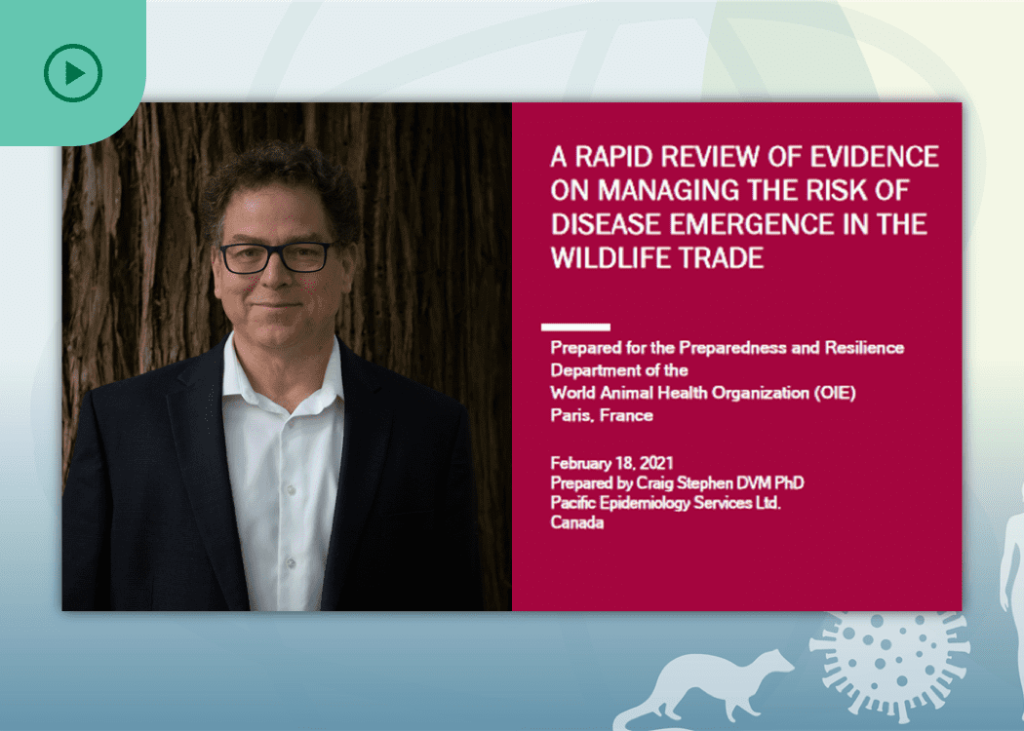
Expert Talk with Richard Kock and Hernán Cáceres-Escobar

About this Event

Identifying and reducing human health risks from wildlife trade needs an internationally coordinated and cooperative approach. To this end, the International Alliance against Health Risks in Wildlife Trade serves as an inclusive and interdisciplinary platform to discuss challenges and formulate solutions vis-á-vis human-wildlife interfaces and associated health risks and the emergence and spread of zoonotic pathogens from wildlife.

During this online session Richard Kock and Hernán Cáceres-Escobar shared their insights from investigating the links between wildlife and the emergence of human infectious zoonoses and EIDs. They are both lead authors of the upcoming “Situation analysis on the roles and risks of wildlife in the emergence of human infectious diseases” by the IUCN Species Survival Commission (SSC). As member of the Alliance, you may access their “Highlights” in the Alliance’s Library.

About the Speakers

Richard Kock is a wildlife veterinary ecologist, infectious disease researcher and conservationist and was co-chair of the IUCN SSC Wildlife Health Specialist Group (2004-2021). He has worked almost entirely in the field of wildlife health and disease since 1980 with a focus on African and Asian ecosystems. He is on the WHO IHR and OIE Crisis Management Committee expert list, an Associate Research Fellow at Chatham House and past Council Member of the Wildlife Disease Association where he remains active on various task forces and committees, and is an adjunct Professor at Tufts University and Njala University. He holds a chair in Wildlife Health and Emerging Diseases, leading a research portfolio currently of £1.5 million pounds in the fields of wildlife health and zoonosis at the Pathobiology and Population Sciences Department at the Royal Veterinary College.

Hernán Cáceres-Escobar is a veterinarian and conservation scientist. He studies the links between anthropogenic-driven environmental change, biodiversity loss, and emerging infectious diseases. He uses transdisciplinary participatory approaches and modelling techniques to develop innovative evidence-based interventions and policies for an ever-changing world. He has a diverse international background and practical experience working with multi-cultural teams at the interface of science, policy, and practice with local and indigenous communities, government agencies, NGOs, IGOs, industry partners, and academics. In his current position at Sapienza University, he is combining his skills to explore how anthropogenic-driven environmental change affects disease hazards to create future scenarios of risk.

Expert Talk with Catherine Machalaba

About this Event

Identifying and reducing human health risks from wildlife trade needs an internationally coordinated and cooperative approach. To this end, the International Alliance against Health Risks in Wildlife Trade serves as an inclusive and interdisciplinary platform to discuss challenges and formulate solutions vis-á-vis human-wildlife interfaces and associated health risks. In moving from immediate crisis management of the ongoing global pandemic towards a more long-term perspective, many have realized that preventing future pandemic outbreaks will need to also address health risks in dealing with wildlife trade and potential spillover, and thus prevention at the source.

During this online session Dr. Catherine Machalaba gave insights into how to operationalize One Health approaches for more coordinated, preventive, and cost-effective systems that promote human, animal, and environmental health given their integral links. She elaborated on entry points, trade-offs and co-benefits when designing effective policy options, including land use changes, wildlife trade and livestock management, and where to start as a feasible minimum that has to be done.

About the Speaker

Catherine Machalaba is the Principal Scientist for Health and Policy at EcoHealth Alliance. She was a lead author of the World Bank Operational Framework for Strengthening Human, Animal and Environmental Public Health Systems at their Interface (“One Health Operational Framework”) published in 2018 to assist countries and donor institutions in implementing One Health approaches. She is active in the International Union for the Conservation of Nature (IUCN), including serving for 10 years as Program Officer for its Species Survival Commission’s Wildlife Health Specialist Group. She is also a member of the One Health High-Level Expert Panel to the FAO, OIE, UNEP, and WHO (OHHLEP). She holds a master’s degree in public health and a PhD in environmental and planetary health sciences. 

Expert Talk with Nicole Redvers

About this Event

Identifying and reducing human health risks from wildlife trade needs an internationally coordinated and cooperative approach. To this end, the International Alliance against Health Risks in Wildlife Trade serves as an inclusive and interdisciplinary platform to discuss challenges and formulate solutions vis-á-vis human-wildlife interfaces and associated health risks. In order to prevent future pandemic outbreaks there is the urge of shifting actions towards a more long-term perspective rather than only focussing on immediate crisis management. Thats why one major area will be to address health risks in dealing with wildlife trade to prevent potential spillover events at the source.

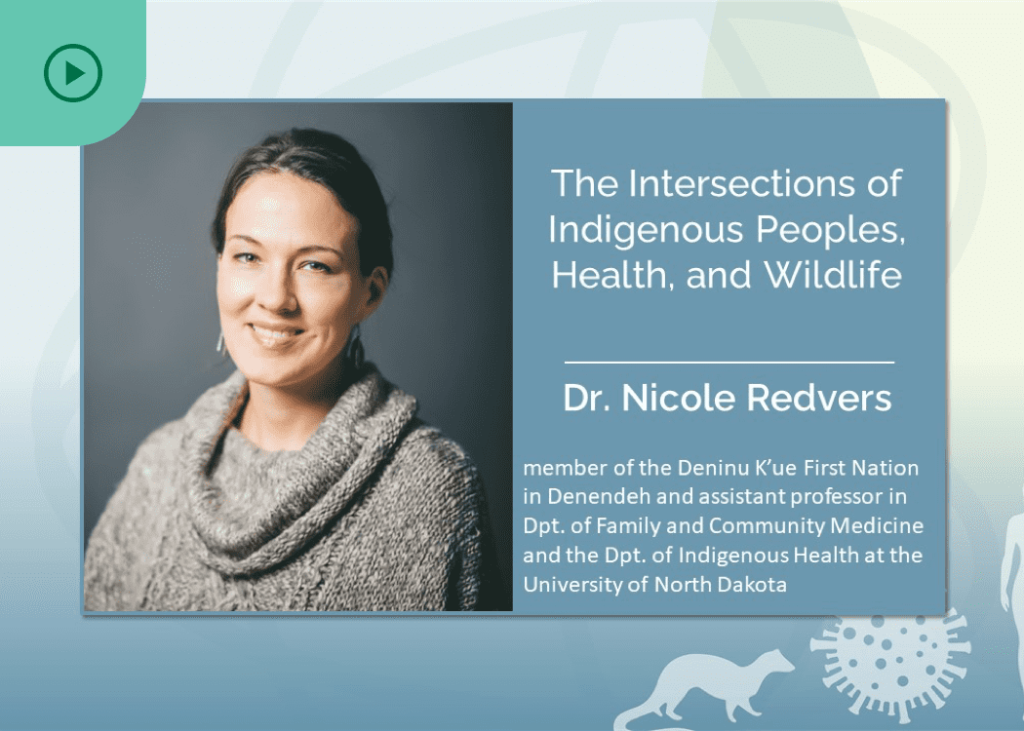
During this online session, Dr. Nicole Redvers provided insights on the wildlife contact and trade related discussion. She elaborated on inclusion of Indigenous Peoples and international protection mechanisms. These mechanisms need to be considered when developing and operationalizing processes that may affect Indigenous cultural identity, traditional knowledges, and practices as it pertains to wildlife subsistence. She also talked about potential implications within the One Health and greater Planetary Health approaches to deal with complex problems.

Redvers wildlife trade

About the Speaker

Dr. Nicole Redvers, ND, MPH, is a member of the Deninu K’ue First Nation in Denendeh (NWT, Canada) and has worked with Indigenous patients, scholars, and communities around the globe her entire career. She is an assistant professor in the Department of Family and Community Medicine and the Department of Indigenous Health at the University of North Dakota where she helped developed and launch the first Indigenous health PhD program. Dr. Redvers is co-founder and current board chair of the Canadian charity the Arctic Indigenous Wellness Foundation based in Yellowknife, NWT, providing traditional Indigenous-rooted Land-based wellness supports to northerners.  She has been actively involved at regional, national, and international levels promoting the inclusion of Indigenous perspectives in both human and planetary health research and practice. She is author of the trade paperback book titled, ‘The Science of the Sacred: Bridging Global Indigenous Medicine Systems and Modern Scientific Principles’.

Expert Talk on how wildlife movement data could help in preventing the spread of infectious diseases with Martin Wikelski

About this Event

Identifying and reducing human health risks from wildlife trade within a One Health framework needs an internationally coordinated and cooperative approach. Preventing future pandemic outbreaks will need to also address health risks in dealing with wildlife trade, contact and potential spillover, and thus prevention at the source. To create a platform to foster exchange, aiming to reduce the risk of future pandemics, the International Alliance against Health Risks in Wildlife Trade is cordially inviting you to the upcoming expert talk.

wildlife movement data

As the founding Director of the Max Planck Institute of Animal Behavior and Professor in Biology at the University of Konstanz, Prof. Dr. Martin Wikelski investigates global animal movement with the goal of creating an intelligent sensor network of animals—the “Internet of Animals”—and protecting animals worldwide. He has pioneered a system for continuously tracking thousands of animals from space, ICARUS, and in doing so has opened up a frontier in harnessing animal observation as a tool for conservation and more effective management of and response to health risks. Martin Wikelski will share some of the latest data on animal movement around the planet. He will highlight how this helps us to preserve biodiversity, to secure our global food supplies, to anticipate pandemics and potentially to predict natural disasters. Previously, he worked at, among others, University of Washington, Seattle, Smithsonian Tropical Research Institute, Panama, University of Illinois Urbana-Champaign, and Princeton University.

Wildlife health: What is at stake?

For the occasion of World Wildlife Day, the World Organisation for Animal Health (WOAH) is organising an interactive webinar. Panellists from leading wildlife organisations will help raise awareness on the importance of wildlife conservation and the threats faced by wild animal species.

WOAH is the global authority on animal health. Through our Wildlife Health Framework, we aim to strengthen Member’s capacity to manage the health of wildlife. We notably develop guidelines to accompany our Members in the surveillance of wildlife health. Working alongside conservation organisations, we leverage resources and expertise to coordinate efforts more effectively and promote knowledge in this field.

The one-hour panel discussion: “Wildlife health: what is at stake?” will bring together key international partners in wild animal conservation.

Hosts

  • Keith Hamilton, Head of the Preparedness and Resilience Department — WOAH.
  • Ana Nieto, Head of Species Conservation Action — International Union for Conservation of Nature (IUCN).

Panellists  

  • Susan Lieberman, Vice-President, International Policy — Wildlife Conservation Society (WCS).
    WCS is a non-governmental organisation dedicated to the preservation of the world’s greatest wild areas. 
  • Maria Forzán, Officer — Wildlife disease Association (WDA).
    The WDA promotes healthy wildlife and ecosystems, biodiversity conservation, and environmentally sustainable solutions to One Health challenges. 
  • Peregrine Wolff, Executive manager — Wildlife disease Association (WDA).
    The WDA promotes healthy wildlife and ecosystems, biodiversity conservation, and environmentally sustainable solutions to One Health challenges. 
  • William B. Karesh — EcoHealth Alliance and IUCN.
    EcoHealth Alliance develops science-based solutions to prevent pandemics and promote conservation.

About World Wildlife Day

Every March 3rd, the global community celebrates World Wildlife Day to shine a light on issues impacting wild animals and plants and their conservation.

Join the conversation using
#WWD2023

Photo: bert b

World Wildlife Day – Partnerships for Wildlife Conservation

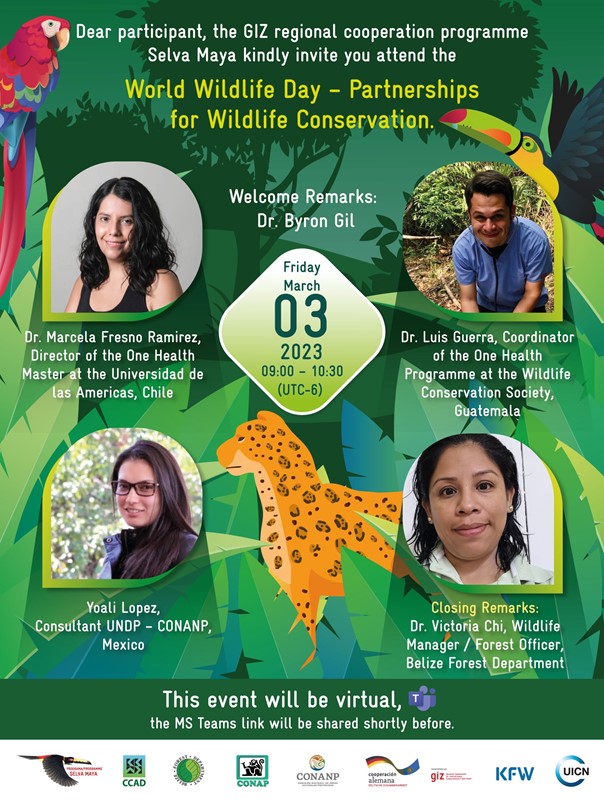
Within the context of World Wildlife Day on March 3rd, 2023, at 16:00 CET (09:00 UTC-6), the GIZ regional cooperation programme Selva Maya organizes an online session on regional and international partnerships for wildlife conservation with experts from Latin America. We are excited to announce that Dr. Marcela Fresno Ramirez, Director of the One Health Master at the Universidad de las Americas, Chile, and Alliance Steering Committee member will present the International Alliance against Health Risks in Wildlife Trade.

We cordially invite everybody who is interested to participate in the event. The MS Teams link will be shared shortly before.

World Wildlife day

Photo: Zdeněk Macháček

Expert Talk on Radical Listening with Dr. Sakib Burza, Medical Director at Health in Harmony

Indigenous peoples make up just 5% of the world’s population, yet they manage 25% of the earth’s land and support 80% of the earth’s biodiversity. Tropical forest protection is key to lowering the Earth’s temperature by 1.5 degrees Celsius and meeting the pledge set forth by the Paris Climate Agreement in 2015. Appropriate mechanisms must be identified to create a trustworthy environment to listen, learn and understand the importance of being guided by Indigenous and local communities to be able to develop inclusive and effective lines of action for primary pandemic prevention.

Radical Listening is an example of contextualizing the perspectives of rainforest communities as implemented by Health in Harmony. Internationally coordinated and cooperative approaches to identify and reduce health risks from our distorted relationship with nature and wildlife must be inclusive and respectful of Indigenous knowledge systems and their communities needs and traditions. To create a platform to foster exchange, aiming to reduce the risk of future pandemics, the International Alliance against Health Risks in Wildlife Trade is cordially inviting you to the upcoming

Expert Talk with Dr. Sakib Burza

Wednesday, March 1st, 14:00-15:15 CET

Click here to join the meeting.

By partnering with local organizations and governments, Health in Harmony works alongside 135,000 Indigenous, Traditional, and rainforest peoples, protecting over 8.8 million hectares of high-conservation value rainforest in Indonesia, Madagascar, and Brazil. Sakib Burza will explore how this approach relates to the Alliance’s work, what insights from Health in Harmony’s scientifically confirmed work should be included in regulatory frameworks, and what conclusions might be drawn for members of the Alliance.

About the speaker

Dr. Sakib Burza directs the medical and emergency response components of Health in Harmony, while also developing the evidence base of operationalising planetary health. Sakib has been working in the humanitarian health sector since 2003, gaining experience across Africa, Asia and the Middle East, most recently completing a 6-year stint as the Asia Medical Operations lead for Doctors Without Borders, Spain. Through working with many human made and natural disasters, Sakib learned that a focus purely on human health without understanding and utilizing the role of the shared environment was a great missed opportunity to improve the wellbeing of all living beings, and not doing so would ultimately result in a cycle of failure.

A practicing physician, Sakib maintains an honorary Associate Professor position in the Clinical Research Department at the London School of Hygiene and Tropical Medicine, and is a Visiting Professor at the Institute of Tropical Medicine at Nagasaki University. Sakib received his medical degree from the University of Edinburgh and a Family Medicine specialization from the Royal College of General Practitioners. He then completed a Masters of Science in Public Health in Developing Countries at the London School of Hygiene and Tropical Medicine, and then a PhD in Medicine at the Institute of Tropical Medicine in Antwerp. He is interested in neglected tropical diseases, apes, mountains, kayaking, tall trees, and his family (not in that order…).

About the Alliance

The International Alliance against Health Risks in Wildlife Trade serves as an inclusive and interdisciplinary platform to discuss challenges and formulate solutions vis-á-vis human-wildlife interfaces and associated health risks and the emergence and spread of zoonotic pathogens from wildlife. The Alliance is aiming to enhance international and national awareness, knowledge, policies and action, not least by narrowing the gap between science and implementation.

We are very much looking forward to jointly learning from Sakib Burza’s findings. Please feel free to forward and share this invitation with interested colleagues.

COP 15 High-Level Roundtable

Pandemic prevention: Protecting nature and safeguarding human health

The increasing emergence of new zoonotic diseases, combined with rapid growth in international travel, is pushing the world into an era of pandemics with immeasurable social and economic harm. Human impact on ecosystems, through deforestation and unsustainable land use, harmful animal husbandry practices and wildlife markets and trade, drive the risk of zoonotic spillover.

The post-2020 Global Biodiversity Framework and the Global Action Plan for Biodiversity and Health provide a once-in-a-decade opportunity to reduce the risk of future pandemics of zoonotic origin. They are key to the implementation of a holistic approach to pandemic prevention, encompassing and building on the One Health approach.

This event will be a call to action from diverse leaders of the environment and global health communities. They will highlight win-win strategies for biodiversity conservation and pandemic prevention, and the complementarity of various international initiatives on this topic.

Date: Friday, December 16th
Time: 1:15-2:45pm Local Time EST
Location: Intercontinental Hotel, (next to Palais des Congrès), Ravel room, 360 Rue Saint-Antoine O, Tiohtià:ke (Montréal)

Speakers:

  • STATE SECRETARY JOCHEN FLASBARTH, German Federal Ministry for Economic Cooperation and Development (BMZ)
  • MME BÉRANGÈRE COUILLARD, French Vice-Minister for Biodiversity (TBC)
  • DR. KIM GRÜTZMACHER, Senior Advisor on One Health, Biodiversity and Health at GIZ
  • ANGELA GONZÁLEZ GRAU, Director of the National Commission for Biodiversity Management (CONAGEBIO), Ministry of Environment and Energy of Costa Rica
  • DR. NICOLE REDVERS, Director of Indigenous Planetary Health at Western University’s Schulich School of Medicine & Dentistry
  • DR. CHADIA WANNOUS, One Health Global Coordinator, World Organization for Animal Health
  • MARCO LAMBERTINI, Director General of WWF International 
  • DR. NIGEL SIZER, Executive Director, Preventing Pandemics at the Source Coalition

 … and more to be announced.

Contact for event info and at COP 15: Lina Dieudonné, lina.dieudonne@dalberg.com, +1-438-927-3773

Postponed: ‘Expert Interview’ from the CBD COP with Cristina Romanelli and Dr. Kim Grützmacher

New date tba!

About the Event:
At the ongoing UN Biodiversity Conference (CBD COP 15) in Montreal the achievement and delivery of the CBD’s Strategic Plan for Biodiversity 2011-2020 is reviewed and a final decision on the post-2020 Global Biodiversity Framework shall be taken. This GBF and the Action Plan for Biodiversity and Health provide a once-in-a-decade opportunity to insert the health angle into the biodiversity discourse and concretely help reduce the risk of future pandemics of zoonotic origin. They are key to the implementation of a holistic approach to pandemic prevention, encompassing and building on the One Health approach.

To give onsite insights from the ongoing negotiations and outlook what comes next, the International Alliance against Health Risks in Wildlife Trade is thrilled to host an

Postponed: Expert Interview from the CBD COP
with Cristina Romanelli and Dr. Kim Grützmacher
new date tba

Both will share with us their impressions of the dynamics in Montreal, specifically focusing on the intersection of health topics in the biodiversity discourse. They will offer insights from the negotiations and report on outcomes relevant to the Alliance’s goals regarding pandemic prevention at the source and One Health. Together we will look towards the future and consider what impact this COP’s results will have on other ongoing international Biodiversity and One Health processes for pandemic prevention.

About the Speakers:
Cristina Romanelli is a programme officer and focal point on biodiversity, climate and health with the World Health Organization. She has over 20 years of experience in policy evaluation and development, multi-stakeholder engagement, capacity-building, and interdisciplinary research at the nexus of biodiversity conservation and management, global health, climate change, and One Health. She has provided high-level scientific and policy advice in research and regulatory-compliance settings, primarily in the areas of biodiversity and ecosystem management and conservation, global and public health, One Health, climate change, and regulatory energy policy. She also managed the WHO’s Joint Work Programme on biodiversity and health with the Convention on Biological Diversity (CBD), and now co-leads the WHO-IUCN expert working group on biodiversity, climate, One Health and Nature-based Solutions.

Dr. Kim Grützmacher is a Senior Advisor One Health / Biodiversity and Health in the secretariat of the Alliance and member of the GIZ observer mission to the CBD COP. She is also thematic lead for planetary health at the Museum für Naturkunde (MfN) / Leibniz Institute for Evolution and Biodiversity Science. Previously, she worked as a Program Manager for the Health Program of the Wildlife Conservation Society (WCS). At WCS Kim provided technical guidance on wildlife health and health management issues as they arose for WCS site and species-focused conservation projects, within a One Health framework. Having earned her PhD from the Robert Koch Institute (in collaboration with the Max-Planck-Institute for Evolutionary Anthropology), she advises the German Government as vice-chair of the scientific advisory board on One Health to the German Federal Ministry for Economic Cooperation and Development (BMZ).

About the Alliance:
The International Alliance against Health Risks in Wildlife Trade serves as an inclusive and interdisciplinary platform to discuss challenges and formulate solutions vis-á-vis human-wildlife interfaces and associated health risks and the emergence and spread of zoonotic pathogens from wildlife. The Alliance is aiming to enhance international and national awareness, knowledge, policies and action, not least by narrowing the gap between science and implementation

We are very much looking forward to jointly reflecting on the just finished CBD COP in Montreal. Please feel free to forward and share this invitation with interested colleagues.

High-Level Event: Presenting the Quadripartite’s One Health Joint Plan of Action

Natural History Museum Berlin

We are thrilled to announce that the Alliance will be co-hosting the launch of the Quadripartite’s awaited Joint Plan of Action on Tuesday, 18th October, starting at 18:00 CEST in the Dinosaur Room of the Natural History Museum in Berlin.

The event is co-organized by the four Quadripartite organizations (FAO, UNEP, WHO and WOAH) with support from the Federal Ministry for Economic Cooperation and Development (BMZ), the Deutsche Gesellschaft für Internationale Zusammenarbeit (GIZ) GmbH, the Museum für Naturkunde, and the Foundation Healthy Planet – Healthy People.

The One Health Joint Plan of Action (OH JPA) was developed in response to international requests to prevent future pandemics and to promote health sustainably through the One Health approach. It outlines the commitment of the Quadripartite four organizations to collectively advocate and support the implementation of One Health. It builds on, complements and adds value to existing global and regional One Health and coordination initiatives aimed at strengthening capacity to address complex multidimensional health risks with more resilient health systems at global, regional and national level.

The plan includes six action tracks: enhancing countries’ capacity to strengthen health systems under a One Health approach; reducing the risks from emerging or re-emerging zoonotic epidemics and pandemics; controlling and eliminating endemic zoonotic, neglected tropical and vector-borne diseases; strengthening the assessment, management and communication of food safety risks; curbing the silent pandemic of antimicrobial resistance (AMR) and better integrating the environment into the One Health approach.

*Please be advised that a registration does not guarantee on-site attendance. We will review your registration and respond with further information before the event. All registered participants will receive online access to the event via a live stream.

The High-Level Advocacy Event will serve as an occasion for the Quadripartite members and government representatives to present the plan and discuss the opportunities for implementation, followed by an informal exchange. The program includes:

Moderator:
  • Constanze Riedle, Head of Programme, “International Alliance against Health Risks in Wildlife Trade”, Deutsche Gesellschaft für Internationale Zusammenarbeit (GIZ) GmbH

Introduction and Welcome
  • Svenja Schulze, Minister, German Federal Ministry for Economic Cooperation and Development

Keynote Address
  • Wilhelmina Jallah, Minister of Health, Republic of Liberia (tbc)

Panel Discussion
  • Chadia Wannous, One Health Global Coordinator, World Organisation for Animal Health (WOAH)
  • Francesco Branca, Director, Nutrition and Food Safety, World Health Organization (WHO)
  • Keith Sumption, Chief Veterinary Officer, Food and Agriculture Organization of the United Nations (FAO)
  • Wondwosen Asnake KIBRET, Policy and Partnerships Coordinator, Europe Office, UN Environment Program (UNEP)
  • Thomas C. Mettenleiter, President, Federal Research Institute for Animal Health and Co-Chair of the OH High Level Expert Panel (OHHLEP)

Closing Remark
  • Cem Özdemir, Minister, German Federal Ministry of Food and Agriculture