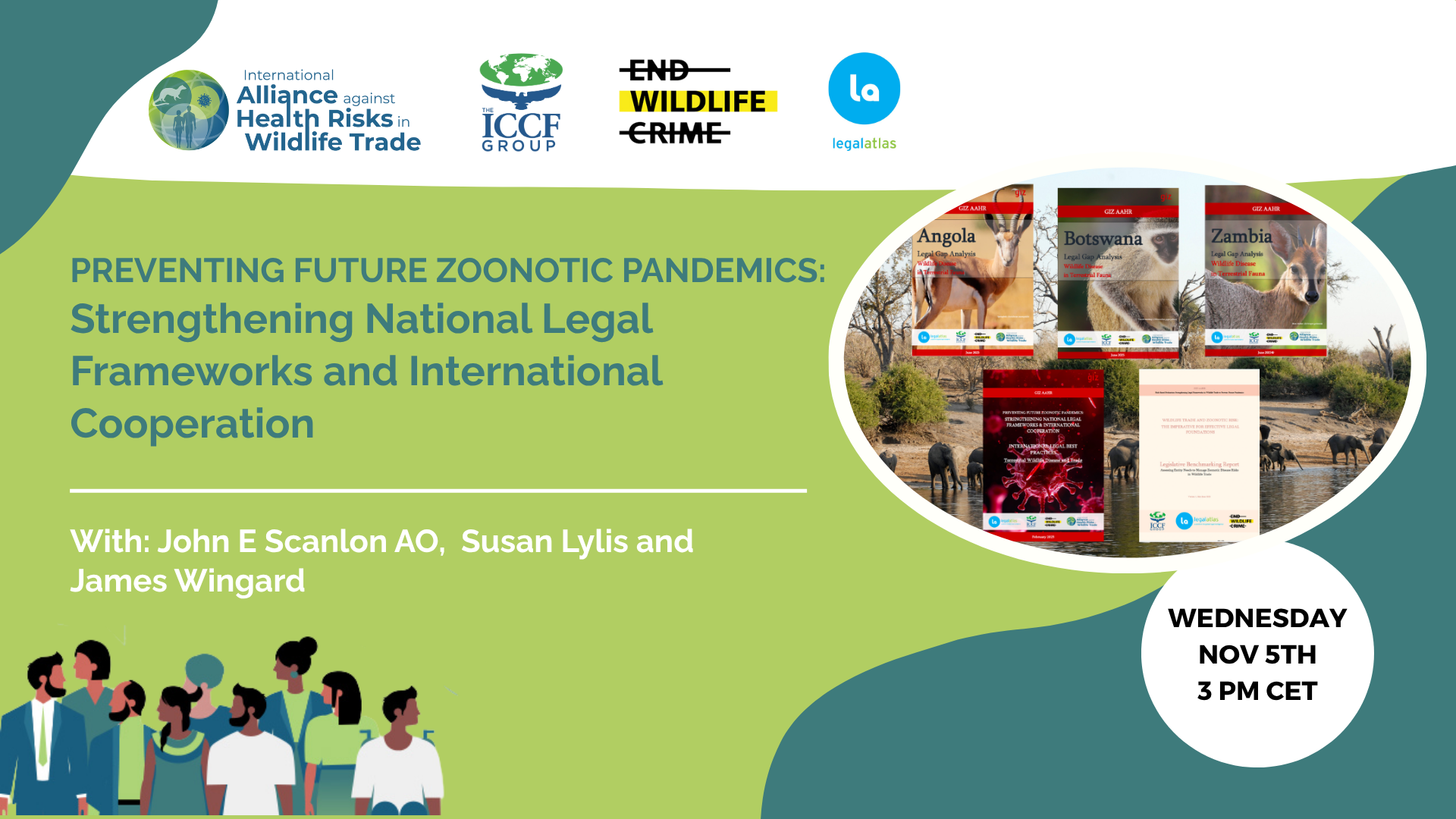
On November 5th, 2025, the International Alliance against Health Risks in Wildlife Trade hosted an open webinar to present the findings of a two-year project conducted by the Global Initiative to End Wildlife Crime (EWC), the ICCF Group, and Legal Atlas. The project, funded by the International Alliance, focused on strengthening national legal frameworks and enhancing international cooperation to prevent future zoonotic disease outbreaks associated with wildlife trade. The project was carried out in close collaboration with Angola, Botswana, and Zambia – countries identified as high-risk due to the presence of key wildlife host species of WHO blueprint diseases.
John E. Scanlon AO, Chair of EWC, opened the event by emphasizing the initiative’s focus on primary prevention of pandemic risks through improved governance of wildlife trade. Susan Lylis, Executive Vice President of the ICCF Group, provided an overview of the project’s scope. She explained that the work was driven by the growing recognition that wildlife-related pathogen spillover is both a conservation and a public health concern. Scientific input by Dr. Dalia A. Conde underscored this urgency: out of the ten most-traded wildlife species capable of hosting WHO blueprint diseases – zoonotic pathogens with pandemic potential and no widely available treatment – eight occur in Angola, Botswana, and Zambia.
James Wingard, Director of Legal Atlas, presented key findings from the legal analyses. One of the most striking results was the identification of a new kind of emerging hotspot in sub-Saharan Africa, where hosts of high-risk wildlife diseases coincide with active wildlife trade. In such settings, he noted, legal gaps become health gaps. The project therefore worked with experts across animal health, public health, wildlife crime, and related fields to identify essential components of effective legislation. National reviews revealed gaps and inconsistencies in legal frameworks, as well as challenges in implementation across the three countries. In total, 41 best practices were identified to support governments and parliaments in strengthening preventive measures.
Paula Lopes, Legal Atlas Coordinator for Angola, outlined several common challenges:
- insufficient integration of One Health approaches in existing legislation,
- limited provisions for rapid outbreak response and place- or species-based risk assessments, and
- a lack of cross-sectoral capacity building from law-making to implementation.
At the same time, she emphasized that all three countries showed strong commitment to international agreements and had well-designated authorities capable of driving progress on the topic of primary prevention regarding the human – wildlife interface. James Wingard added that these foundations make the problem solvable—provided that further analyses expand to additional jurisdictions, and that future efforts increasingly shift from drafting legislation to ensuring its practical implementation.
It was a great honor to be joined by Hon. Nkawana, Member of Parliament in Botswana and co-chair of the Botswana Conservation Parliamentary Caucus, whose participation brought an invaluable governmental perspective to the discussion. Hon. Nkawana shared insights on national implementation efforts. Among them, the inspection of wild meat before it enters markets, working toward establishing an interagency One Health coordination framework with regular parliamentary reporting, and investing in public awareness and multidisciplinary training.
Additional examples from Angola included recent veterinary trainings conducted in October 2025 and the establishment of a new institute for animal disease research – both demonstrate important steps toward operationalizing legal reforms.
During the Q&A session, participants raised forward-looking questions, including whether climate change is shifting zoonotic risks and how ambitious legislative reforms should be: Whether incremental improvements or comprehensive frameworks provide the more effective path.
In closing, the speakers underlined the necessity of continued collaboration between countries and institutions to reduce the risk of future zoonotic outbreaks. During the course of the project, a total of five comprehensive reports were published. These included an in-depth legislative benchmarking report, a concise summary highlighting the 41 legal best practices that were identified, and three country-specific assessments examining how those best practices are applied in Angola, Botswana, and Zambia. They mark an important milestone and will serve as a foundation for scaling the analytical approach to additional jurisdictions. The Secretariat of the International Alliance reaffirmed the Alliance’s commitment to supporting evidence-based, preventive policy solutions at the human–wildlife interface and the importance of the legal efforts on national levels – considering that pandemics always start as local events.
Find the Event Recording here: