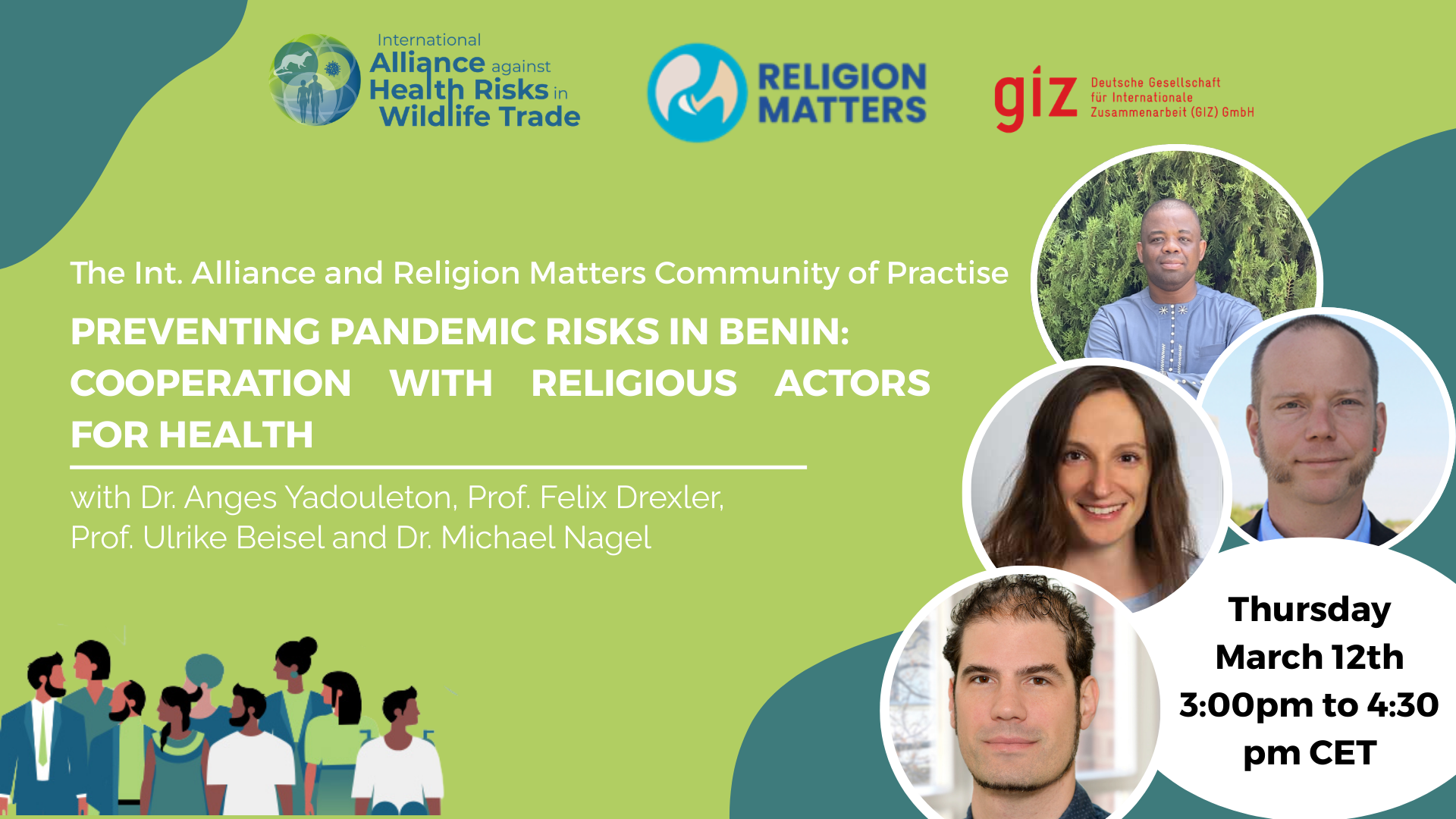
On 12th March 2026, the International Alliance against Health Risks in Wildlife Trade in collaboration with the sector project Religion and Sustainable Development at GIZ welcomed a broad audience to the hybrid expert exchange on ‘Preventing pandemic risks in Benin: Cooperation with religious actors for health’. This event highlighted the results and outcomes of one of the first CONTACT missions initiated by the International Alliance in cooperation with the Charité Medical University Berlin, the Freie University Berlin, University Bayreuth and the National Reference Laboratory in Cotonou, Benin, in the course of 2024 and 2025.
Hosted at the Charité Campus in Berlin, the International Alliance and the sector project welcomed Prof. Dr. Felix Drexler (Head of the Laboratory for Virus Epidemiology, Charité Berlin), Dr. Anges Yadouleton (Director of the National Reference Laboratory for Viral Hemorrhagic Fevers, Benin), Prof. Dr. Ulrike Beisel (Freie Universität Berlin), and Dr. Michael Nagel (Head of the Secretariat of the International Alliance against Health Risks in Wildlife Trade at GIZ) to share their insights and research results on how to address health risks in bushmeat trade and practices in Benin.
Transdisciplinary Exchange
The event presented the results and outcomes from the CONTACT project financed by the International Alliance in Benin. CONTACT is a needs-based governmental consultation facility that supports government in the context of zoonotic spillover risks along the wildlife trade chain, the human-wildlife interface, implementing a One Health approach. The project in Benin brought together a transdisciplinary team from natural sciences, social sciences, development cooperation, and practice.
Integrated Approaches to Pandemic Prevention
The project combined the development of laboratory capacities, such as diagnostics for Lassa fever, Ebola, Mpox and COVID-19, with research into social and cultural practices in the context of wildlife trade and specifically the consumption of bushmeat. A key lesson was that regulatory measures alone, such as bans on bushmeat consumption, are often ineffective, as these practices are deeply embedded in economic and socio-cultural contexts. Instead, the project adopted an integrative approach that considers local realities and engages diverse stakeholders.
Religious Actors as Trusted Partners
The collaboration with traditional and religious actors is essential for building trust and enabling behavioural change. In Benin, religious leaders, particularly within the state-recognized Voodoo, hold strong community influence. They help to raise awareness of health risks and promote safer practices, such as substituting wild animals with domesticated animals in rituals, reducing zoonotic infection risks.
Strengthening Local Capacities
Scientific partners, especially universities, support both risk analysis and the development of local diagnostic capacities. This has significantly improved Benin’s ability to detect and respond to infectious diseases independently. However, understanding the socio-cultural and socio-economic drivers behind wildlife trade and practices also contributes to elaborate risk reduction measures and hence enhances prevention.
Overall, the project addressing zoonotic spillover risks along the wildlife trade chain demonstrates that mitigating health risks requires a holistic approach—one that integrates scientific, social, and religious perspectives and prioritizes long-term cooperation over purely regulatory measures. Find more information on Religion and Sustainable Development here: Home – International Partnership on Religion and Sustainable Development