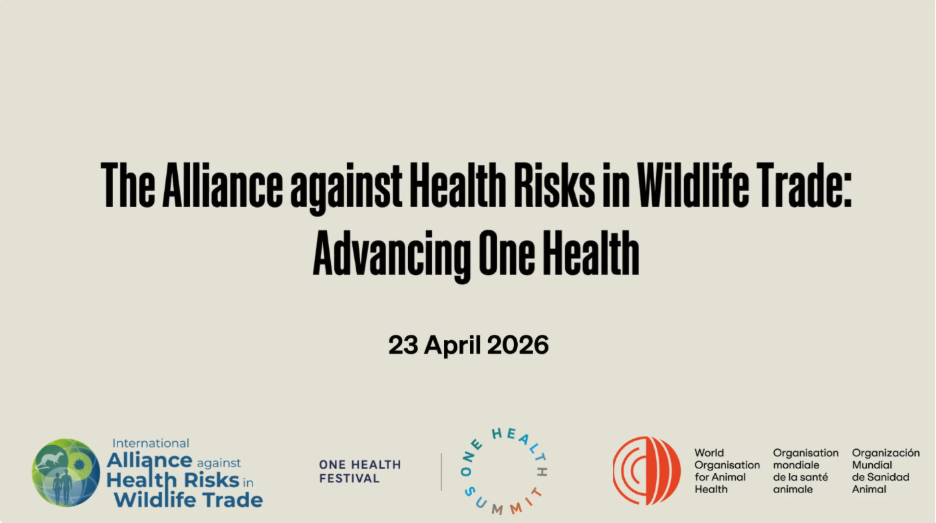
On 23rd April 2026, the International Alliance against Health Risks in Wildlife Trade hosted a side event at the One Health Festival-Summit. This online event brought together experts to discuss how science, policy and practice can be better aligned to address health risks in wildlife trade, while showcasing the Alliance’s work.
Dr Alexandre Fediaevsky, Head of WOAH’s Emergency, Preparedness and Resilience Department, opened the event with an overview of the Alliance and introduced the keynote speaker.
Keynote: Wildlife Trade is a very risky business
Dr Susan Lieberman, Vice-President of International Policy at the Wildlife Conservation Society, made a compelling case on why wildlife trade deserves far greater attention in global health policy. At the heart of her presentation was the concept of prevention at source. This refers to all efforts to stop pathogen spillover from wildlife to humans before it ever happens. As Dr Lieberman argued, this is not only the most cost-efficient strategy for preventing future pandemics while reducing impacts on human health, economies, biodiversity, and climate change. She called for stronger national and international commitments under a One Health approach.
Panel Discussion: From Evidence to Action
A rich panel discussion followed, featuring experts; Craig Stephen (President of McEachran Institute), Matthew Collis (IFAW Senior Director- Policy), Sarah Ferguson (TRAFFIC’s Director of Policy), Barbara Maas (People for Nature and Peace), and Hongying Li (Associate Director of Strategic Operations, Engagement and Impact Columbia Climate School, Columbia University),
Sofia Cortes Calderon, Coordinator of the International Alliance, framed the discussion around a central challenge: how to close the gap between global policy commitments and on-the-ground implementation. Together, opportunities and current barriers standing between current policy and meaningful action were explored.
Key Takeaways
- Wildlife trade risks affect everyone. Through globalisation, urbanisation and ecosystem interdependence, zoonotic risks linked to wildlife trade are not confined to remote markets. They are woven into daily life across the world.
- The risks are humans made. Pathogens do not arise from wildlife alone. Habitat loss, poor animal welfare, species mixing, and stressful transport and market conditions all increase animals’ susceptibility and create conditions for spillover.
- Policy momentum seems to have stalled. Despite some regulatory progress following COVID-19, the urgency to address zoonotic risks has faded. According to some of our experts, governance remains siloed, with animal health; public health and conservation still handled largely in isolation, and global commitments rarely translate into local action.
- Community engagement is essential. The most successful interventions are culturally sensitive, locally owned, and involve a wide range of actors, from government agencies and academia to religious, indigenous and community leaders, to drive lasting behaviour change.
The panel called for concrete action, including improved traceability along trade chains; and a fundamental shift away from business as usual towards systemic change.
Voices from the Field: Success Stories
Two Alliance-supported projects demonstrated what prevention at source looks like in practice:
IUCN Nature4Health Vietnam Project– Presented by Jake Brunner, Head of IUCN’s Lower Mekong Sub-region.
In Viet Nam, illegal wildlife trade poses severe risks to both biodiversity and public health. Working with a broad coalition of partners including WOAH, FAO, national ministries and local communities, the IUCN Nature4Health project strengthened capacities to assess, manage and communicate zoonotic disease risks along wildlife trade supply chains. The project developed and tested risk assessment methodologies for key disease threats and produced practical risk management frameworks that can be replicated across countries and contexts. More information here.
FAO Sustainable Wildlife Management Programme: The Legal Hub – Presented by Eugenio Sartoretto, FAO Legal Officer.
This project addressed a less visible but equally critical dimension of wildlife trade risks: the legal frameworks that govern it. The Legal Hub provides access to national legal texts, cross-sectoral analyses, and AI-supported legal diagnostic tools. This innovative online platform was designed to support evidence-based legal reform and multi-stakeholder engagement, already demonstrating its value as a scalable model across three countries: Namibia, Cameroon and DRC. More information here.
Check THE NEW LEGAL HUB: https://www.fao.org/sustainable-wildlife-legal-hub/en
Closing Reflections
Following a lively Q&A session, speakers converged on a shared conclusion: addressing health risks in wildlife trade is not a niche concern. Everyone is directly or indirectly connected to this. Sustained political will, cross-sectoral cooperation, and community-centred approaches are essential to translating knowledge into action.
The Alliance Secretariat reaffirmed its commitment to bridging science, policy and practice and to supporting the legal and regulatory efforts needed at national and international level to make prevention at source a reality.
Watch the recording here: