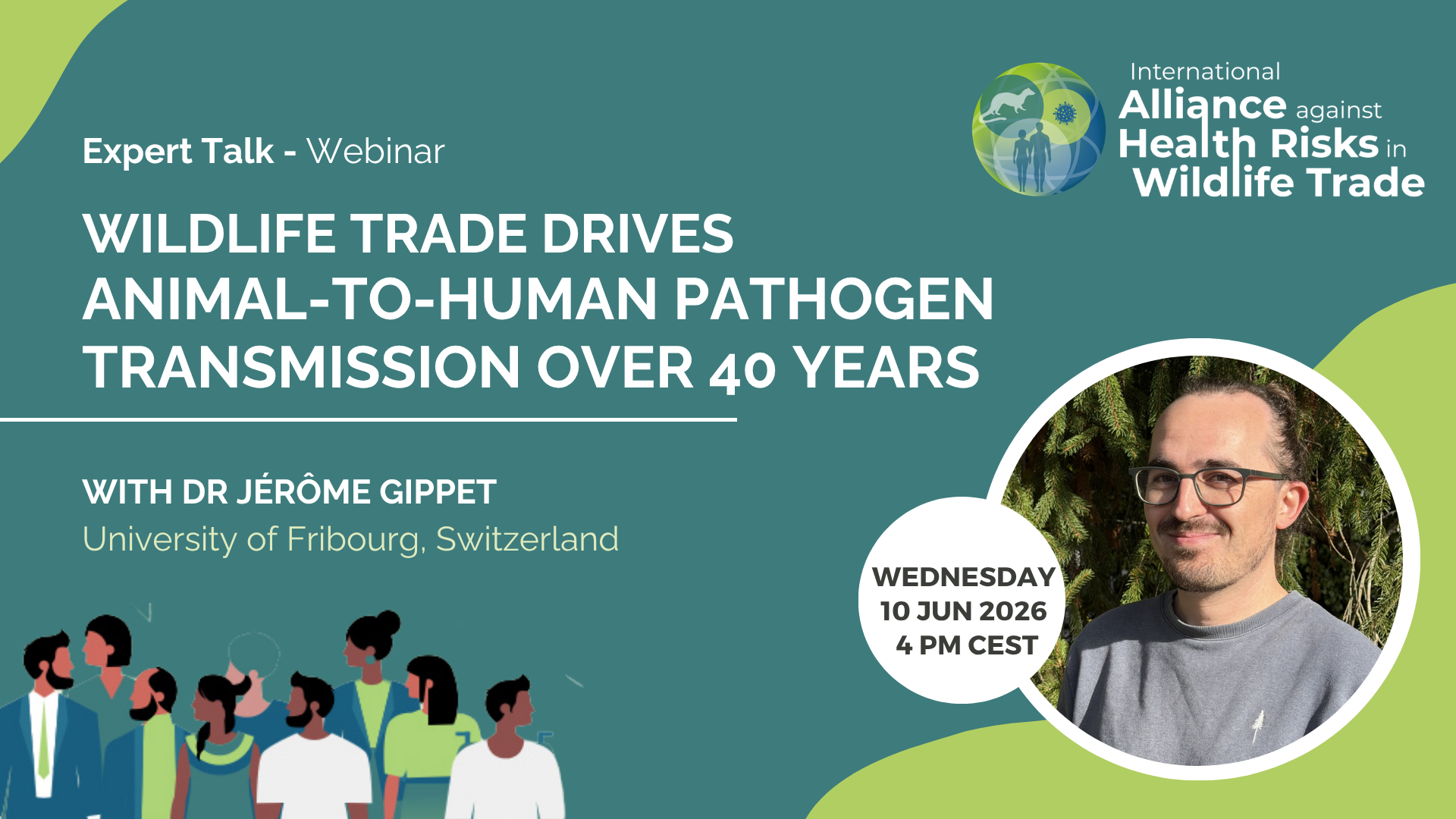
On 10th June 2026, the Alliance’s Expert Talk Webinar featured Dr Jérôme Gippet presenting findings from a recent scientific publication on how wildlife trade has shaped animal-to-human pathogen transmission over four decades.
About the Research
Dr Gippet and co-authors combined 40 years of global wildlife trade records with host-pathogen association data to examine the relationship between wildlife trade and zoonotic risk. Their findings show that traded wild mammals are significantly more likely to share pathogens with humans than non-traded species, and that risk grows with the length of time a species has been present on the global market. Live-animal and illegal trade further amplify this risk as well.
Global wildlife trade brings wild animals and humans into close and repeated contact across the full trade chain, from harvesting and transport to markets, consumption and captivity. Each of these interactions creates opportunities for pathogens to cross species boundaries and potentially trigger infectious disease emergence.
Read the Scientific publication
Key Takeaways
- Wildlife trade is a key driver of pathogen transmission from wildlife to humans. Traded wild mammals are 1.5 times more likely to share pathogens with humans than non-traded species, and as trade continues, new pathogens may emerge.
- The longer the contact, the greater the risk. A temporal analysis of 583 mammal species listed by CITES shows that time spent in trade predicts the number of zoonotic pathogens that a wildlife species hosts. On average, a species shares an additional pathogen with humans for every 10 years it is traded.
- Legal trade does not necessarily mean safe trade. According to Dr Gippet, CITES legal and illegal wildlife trade classifications are focused primarily on extinction risk, not pathogen transmission risk.
- Pathogens do not respect borders. Stronger international instruments are essential for effective global action.
- Domestic markets remain a critical blind spot. International efforts to collect and share domestic wildlife market data are needed.
A lively Q&A session followed Dr Gippet’s presentation, reflecting the strong interest from the Alliance community in the implications of these findings for policy, surveillance and trade regulation.
Watch the recording here:
About the Speaker:
Jérôme Gippet is a postdoctoral researcher at the University of Fribourg, Switzerland. His research explores human–wildlife interactions from both applied and fundamental perspectives in ecology and conservation. Trained as an invasion biologist and urban ecologist at the University of Lyon, he later worked as a postdoctoral researcher at the University of Lausanne, where he investigated emerging exotic pet markets in invertebrates. His research is strongly data-driven and often draws on unconventional sources, such as online pet shops and social media, to better understand wildlife markets and their consequences for biodiversity, invasion dynamics, and pathogen transmission.
This webinar was held in English, with simultaneous interpretation in French and Spanish.